The Grünfeld Defence -
and the historiography of
acoustical recording - a reappraisal
I'd like to begin
with a short extract of a the famous recording – with
which some of you will doubtless be familiar - of
Brahms in 1899 playing his own Hungarian Dance in G
minor. I'd suggest that it's perhaps representative of
how pre-1900 recordings are popularly believed to
sound. As you'll hear, it's virtually impossible even
to discern what Brahms is playing.¹
It was Theo Wangermann, an acolyte of Thomas Edison who made the recording when he came to Europe in 1899 to demonstrate the phonograph machines on display at the World's Fair in Paris. He stayed on in Europe afterwards visiting Berlin and Vienna where he made a series of demonstration cylinder recordings of which the Brahms recording is one.
Here's another of
Wangermann's recordings made on the same trip. In
fact, it was recorded in early November 1899; some two
weeks before the Brahms recording.²
I think you'll agree that the contrast between the two recordings is remarkable. The point I want to make here is that the poor quality, distortion and surface noise of the Brahms recording - so often attributed to early recording technology - is really a property of its reproduction. It's the woeful frailty of the badly worn medium – the wax cylinder in this case – that's the problem, rather than an inadequacy of the recording technology.
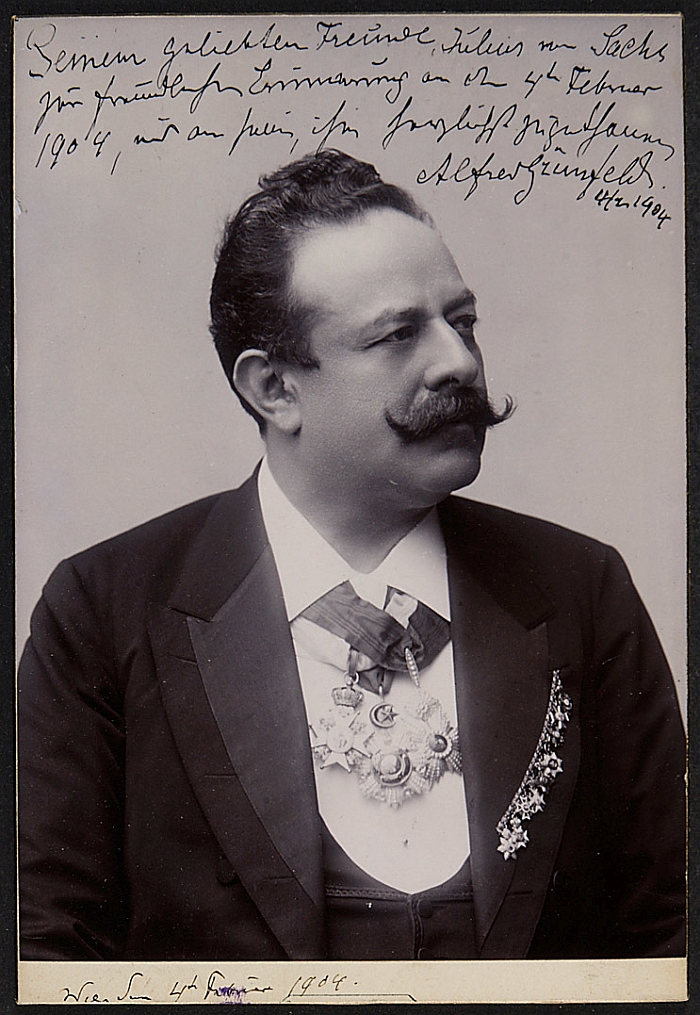
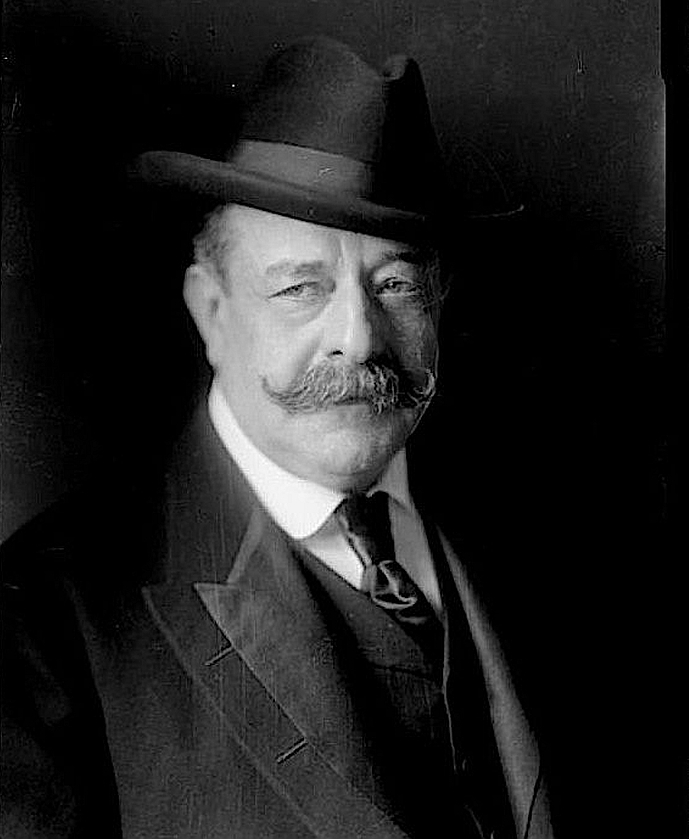
The pianist we heard in this second recording is Alfred Grünfeld ³, a Czech by birth who lived most of his life in Vienna. He was a professional pianist of immense popularity who toured widely throughout Europe and the US.
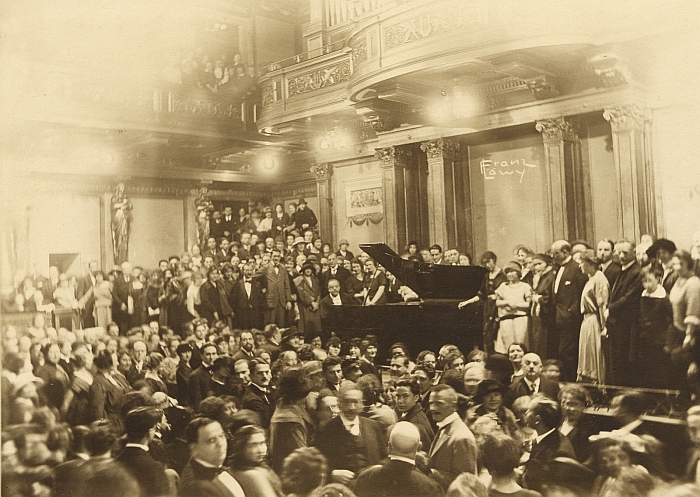
He
became a celebrated salon pianist, writing and
arranging a lot of music in this musical genre which
was extremely popular at the time, and its upon this
that his reputation seems to have come to rest.
However, such circumspect acclaim deprecates the
significance of his recorded oeuvre which includes
works by Bach, Brahms, Debussy, Grieg, Korngold,
Liszt, Schubert, and Schumann many of which –
notably - were first recordings.
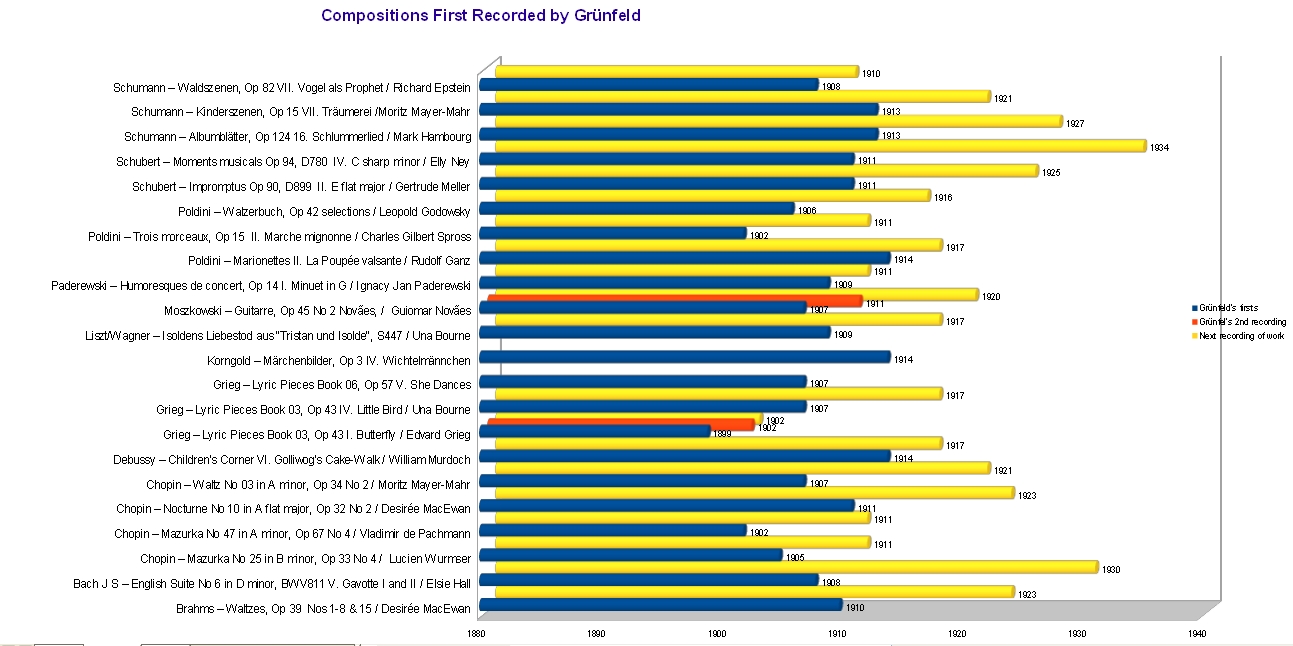
| The above graph shows a list of the 22 compositions – not including his own – that Grünfeld recorded before any other pianist. The dates of his recordings are shown in blue along the X axis; with the yellow bars indicating the date of the next recording of each work The name of the pianist of the second recording appearing after the title of the composition. Some pieces, like the Korngold, were destined never to be recorded again on 78. For others, it was well into the electrical era before they were recorded by another pianist. The two red bars indicate when Grünfeld recorded the work for a second time, but still before any other pianist. The second of these is Grieg's Butterfly which Grünfeld recorded for the first time in 1899 and then again in 1902, the same year as Grieg himself. |
Grünfeld's
performances
of
some of these pieces are fascinatingly characterful
and often in astonishingly good quality. I'll play a
short extract from his 1911 recording of Schubert's Impromptu Op 90 D899 E-flat maj
to illustrate what I mean. 4
So why – given that no other pianist of the acoustical era recorded so prolifically - has Grünfeld languished in such comparative obscurity? Between 1899 and 1914 he made 99 recordings of works by 19 different composers.
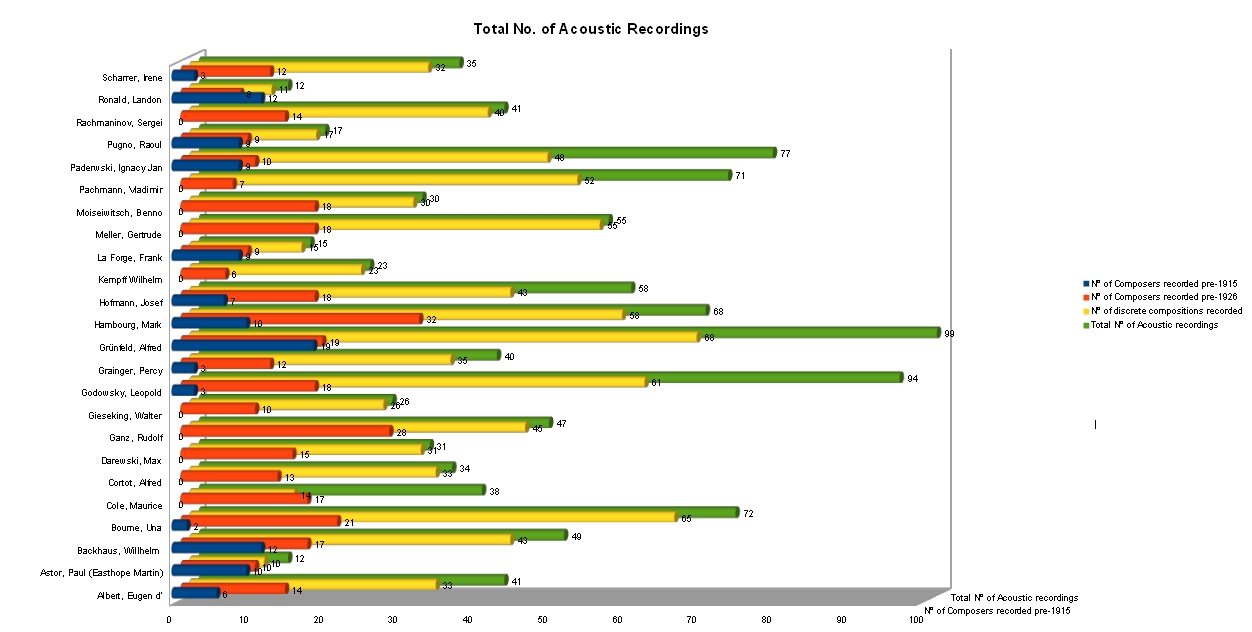
| We see here a graph of the 24 most prolific recording pianists of the acoustical period. The total number of acoustical recordings made by each is shown in green. The number of different or discrete compositions that each of them made appears in yellow, and the number of composers whose compositions each pianist had recorded by 1914, in blue - 1914 being the year of Grunfeld's final recording. The number of composers whose works each pianist had recorded by the end of the acoustical period is shown in red. As you see, only Hambourg, Godovsky, and Una Bourne surpassed Grünfeld in this metric even though he recorded nothing more in the decade before his death in 1924. |
All Grünfeld's recordings were made in Vienna and all were recorded acoustically - which perhaps provides a clue as to why he and his recordings aren't better known. Certainly, their age and rarity means that the original 78s are difficult to obtain. But more pertinently, his career, unlike that of his better-known contemporaries – Paderewski and Pachmann – ended before the 1925 watershed and the start of the electrical recording era.
Industry propaganda
Since the advent of electrical recording, acoustical recordings have been consistently disparaged and negatively compared with their newer, electrically produced counterparts. The mantra that acoustical recordings were inferior was repeated so often and maintained so consistently that the superiority of electrical recordings became widely accepted as a self-evident truism.
The many eccentricities of mechanical recording probably contributed to its demise: its experimentally empirical nature being too ad hoc and unsystematic for assimilation and integration into modern industry: its resistance to synthetic manipulation rendering it incompatible with the precepts of modernism. Although, according to Peter Copeland, acoustical recording technology “was still being used in remote locations without electricity until at least the late 1940s” resistance to the new method was rapidly overwhelmed by the combined forces of commercial imperative and a burgeoning belief in technological progress.
The impression that has been promulgated is that the inherent limitations of acoustical recording constrained normal performance practices: it restricted dynamic range and frequency response particularly in the low frequencies, it imposed on musicians an awkward or unusual layout, it limited sensitivity necessitating – among other things - the use of upright pianos so that the instrument's sound board could be positioned as close as possible to the recording horn; and so on. Whilst all of these criticisms are true enough, it's important to consider the extent to which exceptional instances, recounted and documented precisely because of their extraordinariness, may have given rise to more generalised beliefs about recording practices. For example, instances of singers being wheeled back and forth on trolleys to control audio dynamics were almost certainly exceptional.
I'd like to play another brief example. Grünfeld's
haunting recording of Schumann's Vogel als
Prophet from Waldszenen Op. 82 which beautifully
demonstrates both the subtlety and softness of
his playing as well as the technology's capacity for
recording it. 5
While the demands of acoustical recording technique are apt to be construed as intrusive and disruptive to musicians, the requirements of electrical recording tend to be blithely accepted as necessary adaptations. The requirement on occasions for musicians to accept unconventional or uncongenial placement didn't disappear with the advent of the microphone. Indeed, it continues to this day. Likewise, adaptation of dynamic level to suit the recording medium continued, though with the new technical facility it could now be accommodated surreptitiously. Neither did electrical recording release musicians from the obligation to accept the type of acoustic judged apposite by record company personnel. Rather, additional preconditions were introduced such as the requirement for recorded sound to emerge from and be enshrined in fastidiously maintained silence. Moreover, musical attributes that had formerly been inextricable facets of performance such as volume, presence, and immediacy were re-conceived as discrete, technologically manipulable qualities.
Contemporary photographs and
accounts have been used to foster the belief
that early acoustical piano recordings were
routinely made using upright pianos. Though Alan
Vicat's
1988
discography of Grünfeld
recordings
does
state explicitly that a borrowed upright piano
was
used for his first 1899 recording session,
Stephan Puille (HTW-Berlin University of
Applied Sciences) points to a contemporary
press report in a Viennese newspaper
indicating that a grand piano had in fact been
used for the Wangermann cylinder recording I
played at the start. 6
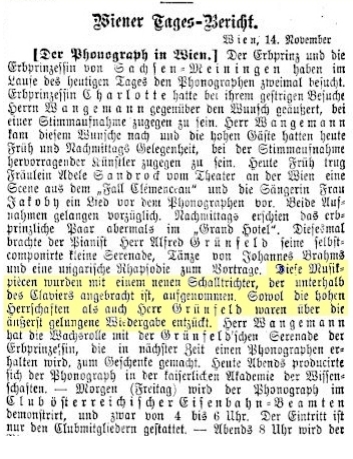
| “These tunes were recorded with a new horn which was mounted underneath the piano. Not only the royal guests but also Mr Grünfeld himself were delighted by the highly successful reproduction.” [trans Xell] |
|
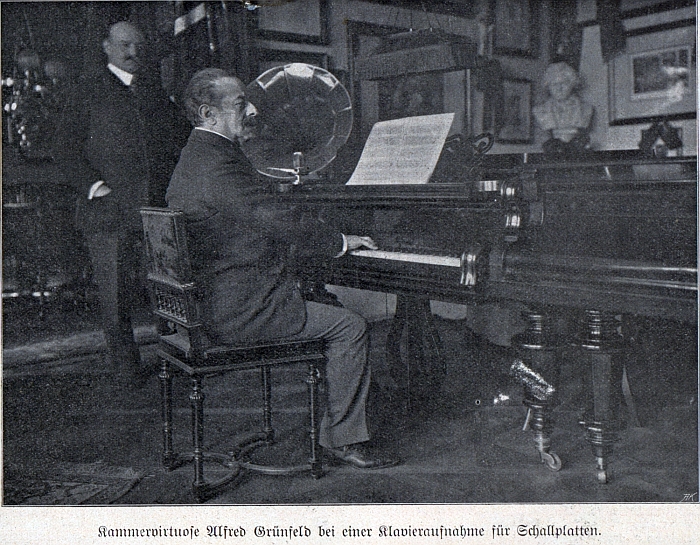
This photograph of Grünfeld at the piano, ostensibly during another recording session, suggests that the Wangermann recording was not exceptional in making use of a grand piano. The subscript reads: Kammervirtuose Alfred Grünfeld bei einer klavieraufnahme fur Schallplatten Chamber virtuoso Alfred Grünfeld recording a piano for records. [trans AH] |
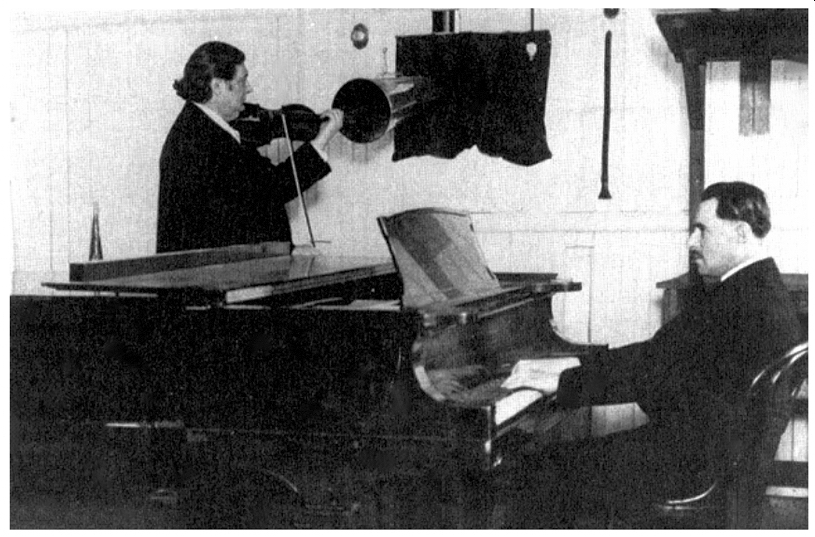
Other photographs of
recordings - Ysaye and Camille Decreus seen here in the
Columbia studios in 1912 - also suggest that a grand piano
was, by this date, already a studio fixture.
As Robert Philip explains;
“Pianists in the early days had to play on an upright piano on a platform at the level of the singer's head, so that the recording horn had a chance of capturing some of its sound. Raoul Pugno, one of the first major pianists to go into the recording studio, made solo recordings under these conditions in 1903. When Paderewski made his first recordings, in 1911, Fred Gaisburg took the recording equipment to the great man's home, and recorded him on his own grand piano. From then on, solo piano recording soon became well established, and grand pianos were routinely used in the studio.” 7
Though acoustical recordings do indeed fall short of electrical recordings according to the metrics of high-fidelity, many listeners – particularly those who have access to the original shellac discs and the acoustic reproducers on which to play them – discover, perhaps inexplicably in objective terms, a naïve, qualitative faithfulness to actual experience that is absent from later recordings for all their polished, modernistic sheen.
I've, long been fascinated by the striking realism of some acoustical recordings; particularly those of the voice, when replayed on an acoustical reproducer – a horn gramophone. What one hears, for all the inadequacies of the medium, seems, in the best, though by no means all instances, extraordinary lifelike fidelity. What I mean here by fidelity is not the high-fidelity of the German Deutsches Institut für Normung (DIN) that defines audio fidelity according to the purely technical characteristics of an electronic signal - but fidelity to actual lived experience 8. The various electronic media on which we all depend ever more heavily enjoin us to conflate our perception of natural acoustical sound with its electronically mediated simulation. Yet for me, and I presume at least some others, the two types of experience remain quite distinct. The fact that the nature of the difference has yet to be specified, still less quantified, in no way invalidates the distinction.
The point here is twofold: firstly, that it's challenging even to experience acoustical recordings without situating them within the paradigm of modern mediated sound to which we are predisposed; and secondly, that the process of electrical transfer and digitization is itself a form of mediation that alters the very nature of historic recordings; forcing compliance with the mediated paradigm.
Remastering Acoustical Recordings
Various techniques for equalising disc recordings were developed during the electrical era to overcome inherent limitations of the recording format and to improve the signal-to-noise ratio. While equalisation curves invoked during recording need to be inverted when the recording is replayed and digitized, there is little justification, beyond aesthetic preference, for altering the sound of acoustical recordings in this way since no such emphasis equalisation was used or even possible in the acoustical period. Nevertheless, conventional remastering technique today encourages equalisation of acoustical recordings, to amplify frequencies below about 200Hz and enhance the bass frequencies that are otherwise reproduced rather weakly. Certainly, this is effective in attuning acoustical recordings to contemporary expectations, yet, at the same time, it runs roughshod over the kind of fidelity I'm concerned with here. The argument for invoking equalisation hinges on a desire to accord acoustical recordings with an aesthetic quality the propensity for which did not even arise until the electrical era.
Though analogue recordings are today apt
to be accorded almost hallowed reverence, the
acoustical recordings that were their precursor are
largely disparaged and neglected. The microphone transmutes
acoustical sound into an electrical signal which, as the term
'analogue' suggests, is merely analogous to sound, while acoustical
recording inscribes the actual physical vibrations of
sound itself. As such, and in the best cases, it
constitutes a noteworthy, even remarkable empirical
document of the past. To do justice to the recorded oeuvre
of Grünfeld and his
contemporaries, we may need to
rediscover and cultivate the necessary listening
dispositions.
© Andrew Hallifax 2021
FOOTNOTES
² Wangermann's 1889-1890 European Recordings available at National Parks Service
https://www.nps.gov/media/video/view.htm?id=2C38AAEB-155D-451F-6781BAE011F0F974
³ Alfred Grünfeld - https://www.europeana.eu/portal/record/15503/FS_PK263424alt.html
4 Schubert Impromptus Op. 90 D899 No. 2 in E-flat major Gramophone Co. 045537 Matrix 578m Recorded Vienna 19th October 1911. Transfer Hallifax
5 Schumann Waldszenen Op. 82 vii Vogel als Prophet: Gramophone Co. 45558 Matrix 13301 u. Recorded Vienna 16th July 1908. Transfer Hallifax
6 Die Presse - 18891115 - Seite 8 VMS 14 43, ckadranZ, ' Lr. SIS Österreichesche Nationalbibliotek
http://anno.onb.ac.at/cgi-content/anno?aid=apr&datum=18891115&seite=8&zoom=33&query=%22Gr %C3%BCnfeld%22&ref=anno-search
Also see Stephan Puille Johannes Brahms in the Lindström Recording Studio
http://www.phonomuseum.at/wp-content/uploads/2011/11/L3-Puille.pdf
7 Philip, Robert – Performing Music in the Age of Recording Yale University Press 2004
8 In fact, the EU EN61305 that superseded the German DIN 45500, is no longer in use. So there appears to be no defined standard. see https://de.wikipedia.org/wiki/High_Fidelity